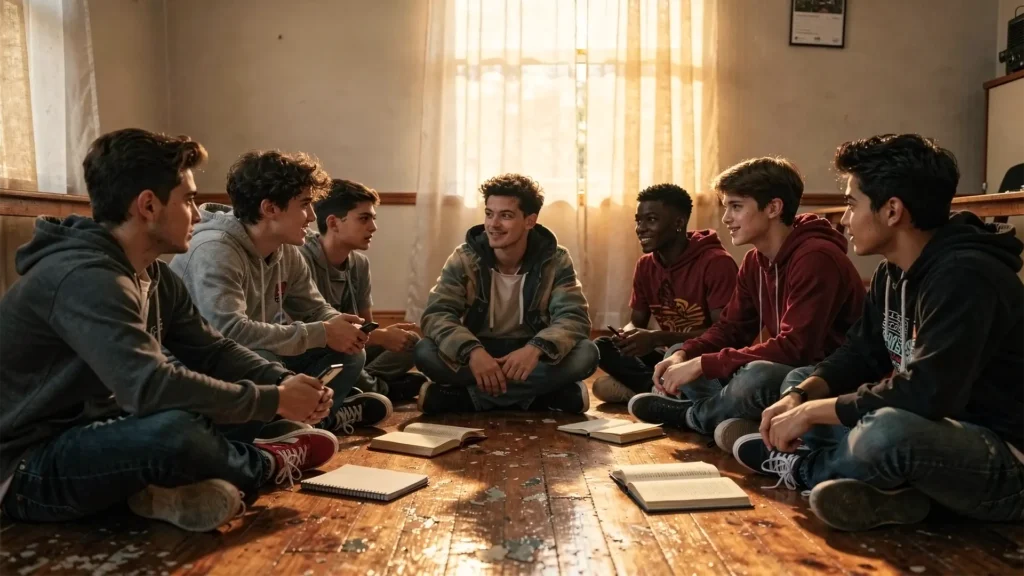
Boys need spaces where they can practice healthy masculinity together—where vulnerability is rewarded, not punished, and where they can question toxic scripts without performing for girls or defending themselves to adults.
‘Unscripted’ provides examples for these conversations. This guide provides the structure.
Who this is for:
– Youth group leaders
– School counselors running boys’ groups
– Therapists facilitating group therapy
– Coaches wanting to build healthy team culture
– Community organizers working with young men
What makes this different from general discussion:
Boys in all-male spaces can:
– Admit insecurities without fear of looking weak to girls
– Challenge each other’s toxic beliefs without being labeled “Simp” or “Chad”
– Practice vulnerability with lower stakes than mixed-gender groups
– Build brotherhood based on honesty rather than performance
Essential Ground Rules (Establish These First Session)
1. What’s Said Here, Stays Here
Confidentiality is sacred (except mandatory reporting situations)
No sharing others’ stories on social media or group chats
What happens in this space is protected
2. Respect the Speaker
One person talks at a time
No interrupting, mocking, or dismissing
You can disagree with ideas; you can’t attack people
3. Right to Pass
No one is forced to share personal experiences
Saying “I’d rather not answer that” is always okay
Passing doesn’t make you weak; it means you’re setting a boundary
4. Challenge Ideas, Not People
“That belief is harmful” is okay
“You’re a bad person for thinking that” is not
We’re here to grow, not to tear each other down
5. Phones Away
No recording, no texting, no scrolling
Full presence required
Phones collected at the door if needed
6. Accountability Without Shame
We all have toxic beliefs we’re unlearning
Admitting you’ve messed up is brave
Growth matters more than being right
7. No Performing
You don’t have to be the toughest, funniest, or most confident
Honesty over performance
We’re practicing being real
Facilitator’s role in ground rules: Model enforcement consistently. If someone breaks a rule, address it immediately but without public shaming: “Hey, that’s not how we do things here. Let’s try again.”
Session Structure (90 minutes recommended)
Opening Circle (10 minutes)
Go around the circle: – Name – One-word check-in: How are you feeling right now? – Optional: Share one thing that happened this week (good or bad)
Why this matters: Gets everyone’s voice in the room early. Practicing speaking in front of the group lowers barriers later.
Scene Reading & Initial Reaction (15 minutes)
Choose a scene to focus on. Options:
For body image/insecurity:
Chapter 4: Ben’s visualization scene where he acknowledges his body shame
Chapter 5: Eddie at the gym, measuring himself
Chapter 14: Ben’s shower scene where he confronts his body shame
For toxic masculinity:
Chapter 3: Percy, Jake, and Liam’s crude talk about girls
Chapter 8: School-ending ritual where Ben, Chris, and Alfie share cringe moments
Chapter 21: Ben and Hannah sharing their virgin status
Chapter 27: Ben and Hannah sharing their experience of witnessing Libby and Chris
Chapter 29: Brotherhood ritual where Ben, Chris, and Alfie share secrets
For consent/violation:
– Chapters 31-32: Percy’s Instagram violation and aftermath
Process:
Read the scene aloud (or have group members read different character parts)
Sit in silence for 30 seconds after finishing
Go around: one-word reaction to the scene
Facilitator tip: Don’t interpret yet. Just collect reactions. This shows there’s no single “right” response.
Small Group Discussion (20 minutes)
Break into groups of 3-4. Give each group one question to discuss:
Questions by theme:
Body Image:
“Ben compares himself to Eddie and feels worthless, both as status and physique. Do guys really do this? What’s that like?”
“Ben also compares himself to Chris, just to focus on his own perceived inadequacy. Do guys really do this? What’s that like?”
“What would it take for Ben to believe he’s ‘enough’ as he is?”
Toxic Masculinity:
“Percy says Looks, Money, Status are all that matter for guys. Where do you think he learned that?”
“Matt seems to bring ‘scientific’ arguments for his predatory view of boy-girl relations. What do you think about them?”
“Eddie stays silent when his friends or Matt objectify girls. Why is it so hard to speak up?”
Vulnerability:
“Chris, Alfie, and Ben share embarrassing truths and it makes them closer. Does that seem realistic?”
“Chris, Alfie, and Ben go naked together in the basement and it bonds them even closer. Does that seem realistic?”
“What would have to be true for you to share something real with friends?”
Consent:
“Hannah said yes to Eddie, but not to Percy filming. What’s the difference?”
“What do you think Percy was thinking when he decided to livestream?”
“What do you think about Hannah’s rejection of Keira when she asked her to record her experience with Eddie?”
Facilitator role: Circulate between groups. Listen but don’t intervene unless conversation stops or becomes harmful. Take mental notes of interesting points to raise in large group.
Large Group Sharing (20 minutes)
Each small group shares:
One key point from their discussion
One question they’re still struggling with
Facilitator’s job:
Draw connections between groups
Highlight moments of disagreement without forcing resolution
Ask follow-up questions that go deeper
Example facilitation:
“Group A said speaking up is hard because you’ll look weak. Group B said staying silent makes you feel worse. Can both be true?”
“I heard someone say ‘that’s just how guys talk.’ What do you think that costs us?”
Activity / Experiential Component (15 minutes)
Choose one activity based on the scene you discussed:
Activity 1: Rewrite the Script
For toxic masculinity scenes:
“Percy, Jake, and Liam are talking crude about girls. Eddie wants to say something but doesn’t. Pair up and role-play: what could Eddie say that would actually work with his friends?”
Groups present their versions
Discuss: “What made some approaches more effective than others?”
Why this works: Practices intervention skills in low-stakes environment. Shows that challenging friends doesn’t require a lecture.
Activity 2: Body Neutrality Exercise
For body image scenes:
“Stand up. Close your eyes. I’m going to name body parts. When I do, notice what your body does—not how it looks. Like, ‘My legs: they walked me here today. My hands: they can text, draw, hold things I care about.’”
Go through: legs, arms, hands, stomach, chest, face, genitals
Discuss: “What was that like? How is that different from how we usually think about bodies?”
Why this works: Shifts from body-as-image to body-as-experience. Models that bodies have purposes beyond being looked at.
Activity 3: Vulnerability Practice
For connection scenes:
“I’m going to read prompts. You don’t have to answer out loud, but think about your answer. If you want to share, you can.”
Prompts:
– “A time I felt invisible.”
– “Something I’m insecure about that no one knows.”
– “A moment I wanted to cry but didn’t.”
– “Someone I wish I’d stood up for.”
– “A family or peer-group rule I wish I’d broke.”
After reading all prompts: “Anyone want to share about any of these?”
Why this works: Normalizes that everyone has these experiences. Voluntary sharing feels safer than forced disclosure.
Activity 4: Media Literacy Practice
For radicalization/online content:
Show a 60-second clip from Andrew Tate or similar Manosphere influencer (or read a transcript)
“What’s the message? What makes it appealing? What’s wrong with it?”
“Where does content like this lead? What does it cost guys who believe it?”
Why this works: Teaches critical analysis of content their peers are consuming. See full Media Literacy Guide for extended version.
Personal Reflection (5 minutes)
Give each person paper and pen:
“Write down one thing from today that’s sticking with you.”
“What’s one thing you might do differently because of this conversation?”
Don’t collect these. They’re private. But writing forces processing.
Closing Circle (5 minutes)
Go around:
“One word to describe how you’re feeling now.”
“Is there anything you need from this group before you leave?”
Facilitator closing:
Remind about confidentiality
Preview next session’s topic if continuing
“I’m proud of the honesty in this room today. That took courage.”
Handling Resistance and Difficult Moments
“This is gay” / Homophobic Dismissal of Vulnerability
Don’t: Get defensive or lecture about homophobia
Do: “Interesting that you associate being honest about feelings with being gay. What do you think that says about our assumptions?”
Or: “Do you think straight guys can’t have real conversations? Why not?”
“Women do it too” / Deflection
Don’t: Argue about who has it worse
Do: “You’re right that women can also be toxic. But right now we’re talking about what we do and how we can be better. Does the fact that someone else does something make it okay for us?”
Defending Toxic Behavior
Example: “There’s nothing wrong with rating girls. It’s just fun.”
Don’t: Call him a sexist or shut him down
Do: “Help me understand what’s fun about it.” [Let him explain]
Then: “How do you think the girls being rated would feel if they heard? Does that matter?”
Silence / Non-Participation
Don’t: Force participation or call out non-talkers publicly
Do: Check in privately: “I noticed you’re quiet today. That’s okay—just want to make sure you’re alright.”
Also: Structure activities that don’t require talking (writing, pair work)
Disclosure of Serious Issues (Abuse, Suicidal Thoughts, Etc.)
Immediate response: “Thank you for trusting us with that. That took real courage.”
Then: “I want to make sure you get support for this. Can we talk after group?”
Follow up: Mandatory reporting if required. Connection to appropriate resources. Check in regularly.
Dominant Voices Crowding Out Quiet Ones
Strategy: “We’ve heard a lot from [names]. I’d love to hear from folks who haven’t spoken yet. [Specific name], what do you think?”
Or: Use small groups more to distribute airtime.
Progressive Curriculum: 6-8 Week Series
If you’re running an ongoing group, consider this sequence:
Week 1: Body Image and Comparison
Focus: Ben’s journey, Eddie’s gym performance
Activity: Body neutrality exercise
Takeaway: “Your worth isn’t determined by how you measure up”
Activity: “Who am I when no one’s watching?” reflection
Takeaway: “Authenticity requires letting people see us”
Week 8: Moving Forward
Focus: Sunrise ending, characters’ choices
Activity: Similar personal goal-setting for healthy masculinity
Takeaway: “Transformation is ongoing, not a single moment”
Special Considerations
Age-Appropriate Adjustments
Ages 14-15:
Focus more on body image, friendship, family pressure
Less explicit discussion of sexual content
Emphasize that sexual decisions can wait
More structured activities, less free discussion
Ages 16-17:
Can handle full content including sexual themes
Ready for deeper analysis of ideology and systems
Benefit from personal application questions
Need space to challenge adult perspectives
Ages 18+:
May have personal experiences with content in book
Can engage with political/systemic dimensions
Need support distinguishing between past behavior and current growth
Benefit from forward-looking questions about adult relationships
Culturally Responsive Facilitation
Recognize:
Masculinity norms vary by culture
Some cultures have more collectivist approaches to male identity
Religious contexts may shape attitudes toward sexuality and gender
Class and economic pressures affect masculine performance differently
Practice:
Ask about cultural context without assuming
Invite participants to name cultural pressures they face
Acknowledge that healthy masculinity may look different across cultures
Focus on values (respect, honesty, consent) rather than specific behaviors
When to Bring in Guest Speakers
Consider inviting:
Male therapist to discuss mental health (normalizes help-seeking)
Coach who models healthy team culture
Man who left extremist movement (if age-appropriate)
Educator on consent and healthy relationships
Father-son pair willing to discuss their communication journey
Measuring Impact (Without Ruining the Space)
Avoid formal assessments that make group feel like school. Instead:
Informal indicators:
Are boys returning voluntarily?
Are they arriving early/staying late to talk?
Is participation increasing over time?
Are they referencing previous sessions?
Are they challenging each other constructively?
Are they bringing friends?
Optional anonymous feedback:
Monthly: “On scale of 1-5, how valuable was this group? What’s one thing you’re doing differently?”
Final session: “What’s one thing you learned? What’s one thing you wish we’d discussed?”
Self-Care for Facilitators
This work is heavy. You’re holding space for boys to process pain, shame, and confusion about masculinity.
Protect yourself:
Debrief with co-facilitator or supervisor after difficult sessions
Notice your own triggers and have strategies ready
Remember: You can’t support everyone’s change, but you can create conditions for growth
Celebrate small wins (a boy who cried for the first time, someone who challenged a toxic belief)
Seek your own therapy or support as needed
Remember: Just by creating this space, you’re countering the isolation that feeds toxic masculinity. That matters.
Final Word for Facilitators
The boys in your group are learning what masculinity means in real-time. They’re sorting through messages from fathers, brothers, coaches, influencers, and peers—many of which are contradictory and harmful.
You’re offering something different: a space where honesty is rewarded, vulnerability is brave, and growth is possible.
Not every boy will change in visible ways. But every boy who experiences authentic male community—even once—learns that another way is possible.
That knowledge is a seed. You won’t always see it grow. But trust that you’ve planted it.
Thank you for doing this work. It matters more than you realize now.